Once again we have a look at the activities of our young marine scientists. As their internships wind to a close most have volunteered to stay on at the Andaman through the busy Christmas/ New Year period.
They will continue to be hosted by the Andaman Resort and their allowances and research materials costs will come from the generous donation of Thomson Reuters.

Young marine biologists have turned the Coral Nursery into a major attraction for overseas guests.
Determination of growth rate based on linear extension growth of
massive corals by using UV-Light.
by Mohammad Ikram Bin Mohammad Naser

The annual-bands of coral core are the bands or “rings” that formed on the skeletal structure which is similar to the trunks of tree. The bands represent the different year and the skeletal structure also exhibit a regular periodic variation in bulk density reflecting seasonality. The annual-band of the coral skeleton shows the historical record in the different environmental condition. Most of the element and compound that expose to the coral will trap within the aragonite during deposition and this condition will capture a record (Readman et al., 1996).

This study aims to know the growth rate of the massive coral (Eg: Porites, Favia, Goniopora) at Datai bay by using UV light for chronological banding patter that have inside the coral skeleton . The alternating density (high density and low density) represent a year of the coral growth .
The massive coral species around the bay are survey first. Then, the selected massive coral will be cut using metal saw, where the slice/cutting is perpendicular to the main vertical growth axis of the colony. Then, the coral skeleton will let to dry and linear extension analysis will be carried out.
The linear extension method is to identify the year bands or the growth rate of the coral. The coral core will be observed under UV light lamp in a dark box to observe the dark and light bands (the chronological banding pattern). The wavelength of the UV light is 254 nm. When the bands are revealed, the growth rate of the coral will be calculated for Linear Extension Rate. The linear extension rate will be calculated by using a ruler with 0.1 cm accuracy for each year.

Photo illustrating growth rings courtesy USGS
Monitoring of Coral
Health in the Coral Nursery
by Cherylynna Roland

All living things, including the
corals are susceptible to diseases, making monitoring of their well-being
important for further development of nursery maintenance strategies. My task
involved using Indo-Pacific Coral Health Decision Tree to identify known causes
of lesions and described lesions of unknown causes through visual cues, manifested
as alterations in color, shape, size, tissue loss and also growth anomaly of
the polyps or skeleton of the corals (Work & Rameyer 2005).
The growth of lesion was measured using calipers
and analyzed with Coral Point Count with Excel extensions (CPCe V3.4). In the
Coral Nursery, the lesions are due to abrasion from neighboring corals,
accumulation of sediment on the coral colonies, and infestation by tube-building
worms. I tested two strategies to see whether recovery is possible, by
isolating the coral with lesions under the shade, with adequate water flowing
through them, and by fragmenting the healthy coral and transplanting them in mid-water
to avoid contact with sediment and allowing more efficient water exchange
surrounding the fragmented corals. After one month, the corals are showing good
signs of recovery, which can be seen by re-growth of polyps on the once exposed
skeleton.

In the ocean, the ability of
reef recovery is important, as a research by Dixson et.al (2014) shown that both
coral larvae and fish are attracted to the smell of a healthy reef, encouraging
their settlement, and thus making the reef ecosystem complex.
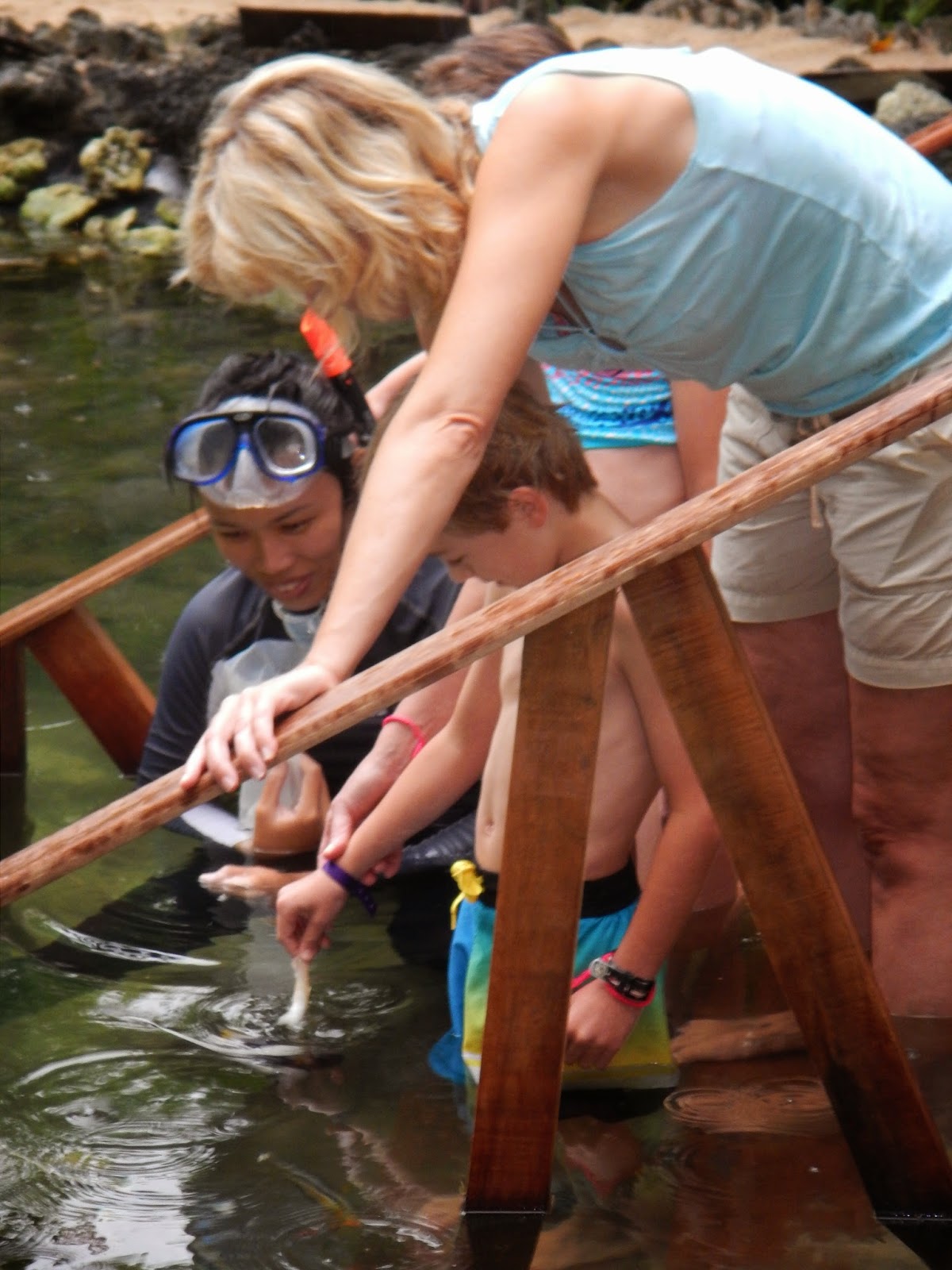
Young guests gain an appreciation of marine life at fish feeding time.

"Hard at work" in beautiful Datai Bay.
goedenquotes.blogspot.com
underwaterinternet.blogspot.com
goedenscience.blogspot.com
goedenshark.blogspot.com
drgerrygoeden.blogspot.com
gerrygoeden.blogspot.com
geraldgoeden.blogspot.com
goedenspress.blogspot.com
einsteinsnature.blogspot.com
youngmarinescientist.blogspot.com
gerryquotes.blogspot.com
goedenmarineecology.blogspot.com
goedenquotes.blogspot.com
underwaterinternet.blogspot.com
goedenscience.blogspot.com
goedenshark.blogspot.com
drgerrygoeden.blogspot.com
gerrygoeden.blogspot.com
geraldgoeden.blogspot.com
goedenspress.blogspot.com
einsteinsnature.blogspot.com
youngmarinescientist.blogspot.com
gerryquotes.blogspot.com
goedenmarineecology.blogspot.com


