Showing posts with label Thomson Reuters. Show all posts

Thursday, September 4, 2014

Thomson Reuters Donation Aids Malaysian Marine Science


Once again we have a look at the activities of our young marine scientists. As their internships wind to a close most have volunteered to stay on at the Andaman through the busy Christmas/ New Year period.

They will continue to be hosted by the Andaman Resort and their allowances and research materials costs will come from the generous donation of Thomson Reuters.


Young marine biologists have turned the Coral Nursery into a major attraction for overseas guests.


Determination of growth rate based on linear extension growth of
massive corals by using UV-Light.

by Mohammad Ikram Bin Mohammad Naser


The annual-bands of coral core are the bands or “rings” that formed on the skeletal structure which is similar to the trunks of tree. The bands represent the different year and the skeletal structure also exhibit a regular periodic variation in bulk density reflecting seasonality. The annual-band of the coral skeleton shows the historical record in the different environmental condition. Most of the element and compound that expose to the coral will trap within the aragonite during deposition and this condition will capture a record (Readman et al., 1996).


This study aims to know the growth rate of the massive coral (Eg: Porites, Favia, Goniopora) at Datai bay by using UV light for chronological banding patter that have inside the coral skeleton . The alternating density (high density and low density) represent a year of the coral growth .

The massive coral species around the bay are survey first. Then, the selected massive coral will be cut using metal saw, where the slice/cutting is perpendicular to the main vertical growth axis of the colony. Then, the coral skeleton will let to dry and linear extension analysis will be carried out.

The linear extension method is to identify the year bands or the growth rate of the coral. The coral core will be observed under UV light lamp in a dark box  to observe the dark and light bands (the chronological banding pattern). The wavelength of the UV light is 254 nm. When the bands are revealed, the growth rate of the coral will be calculated for Linear Extension Rate. The linear extension rate will be calculated by using a ruler with 0.1 cm accuracy for each year.


Photo illustrating growth rings courtesy USGS


Monitoring of Coral Health in the Coral Nursery
by Cherylynna Roland


All living things, including the corals are susceptible to diseases, making monitoring of their well-being important for further development of nursery maintenance strategies. My task involved using Indo-Pacific Coral Health Decision Tree to identify known causes of lesions and described lesions of unknown causes through visual cues, manifested as alterations in color, shape, size, tissue loss and also growth anomaly of the polyps or skeleton of the corals (Work & Rameyer 2005).  

The growth of lesion was measured using calipers and analyzed with Coral Point Count with Excel extensions (CPCe V3.4). In the Coral Nursery, the lesions are due to abrasion from neighboring corals, accumulation of sediment on the coral colonies, and infestation by tube-building worms. I tested two strategies to see whether recovery is possible, by isolating the coral with lesions under the shade, with adequate water flowing through them, and by fragmenting the healthy coral and transplanting them in mid-water to avoid contact with sediment and allowing more efficient water exchange surrounding the fragmented corals. After one month, the corals are showing good signs of recovery, which can be seen by re-growth of polyps on the once exposed skeleton.  


In the ocean, the ability of reef recovery is important, as a research by Dixson et.al (2014) shown that both coral larvae and fish are attracted to the smell of a healthy reef, encouraging their settlement, and thus making the reef ecosystem complex. 
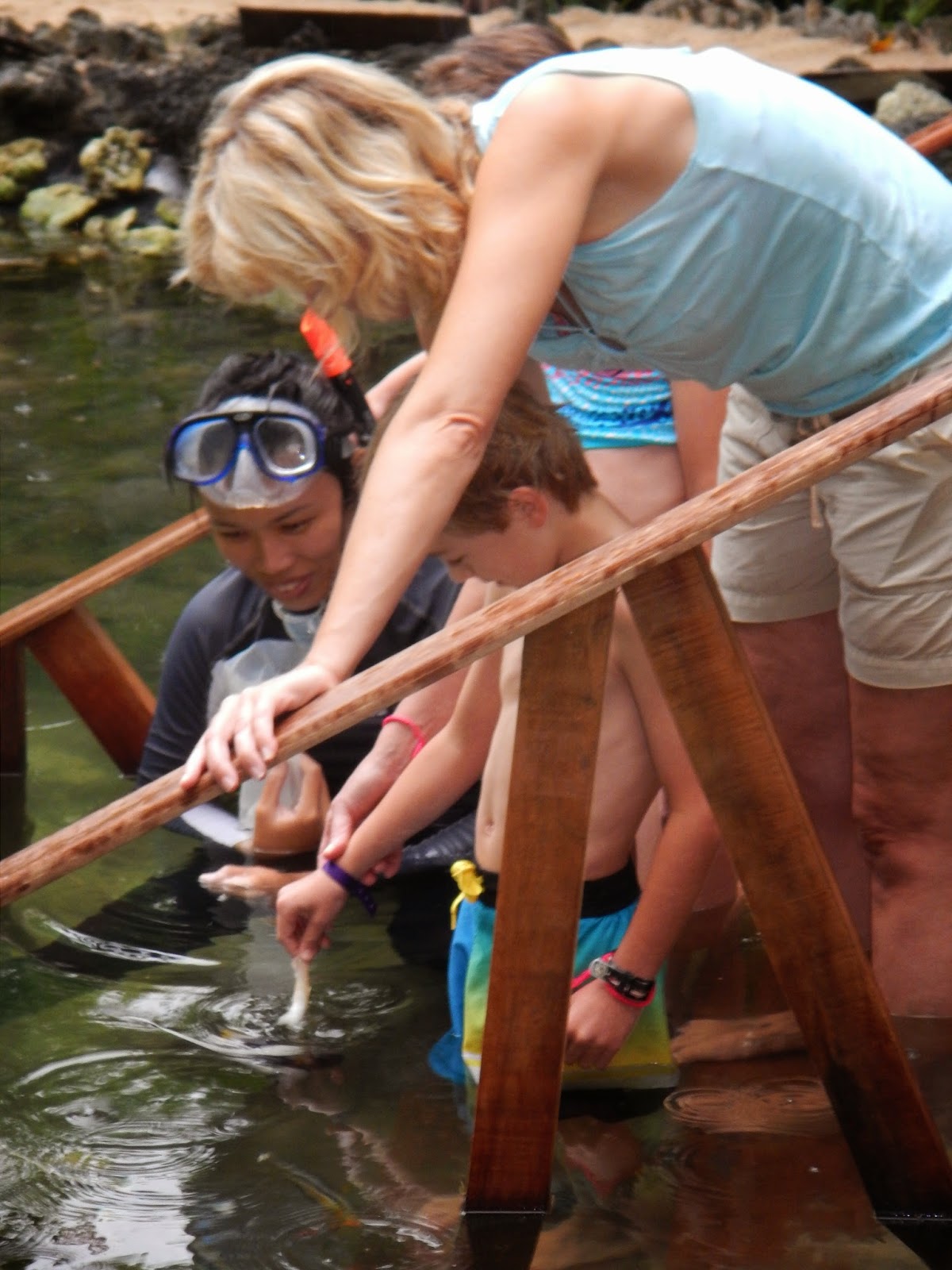

Young guests gain an appreciation of marine life at fish feeding time.


Thursday, August 28, 2014

Andaman and Thomson Reuters Sponsor Marine Scioentists


Dr Gerry introducing the students to the Coral Nursery program.


We have just completed a three months internship program with students from UKM (National University of Malaysia) and UMT (University of Malaysia Terrenganu). 

Seven students were hosted by the Andaman Resort with the provision of food, lodging, and supervision.  Small allowances and minor research equipment were provided by the nature Fund through the contributions of Thomson Reuters.


Coral transplanting with guests was a daily occurrence.

Below are summaries of several of the projects. The remainder will follow in the next posts. All of the numerical results are able to be published through the University giving the graduates evidence of their research ability when job hunting.


A guest is guided through the nursery by an intern marine science student.

But it wasn't all about research. Interns spent long hours transplanting corals and working with guests. Self confidence improved as did language skills. The program was a great success.


Abundance of coral using quadrat method at Datai Bay, Langkawi

by Noor Zalikha Mohamad


The mini project was done on July and August, 2014 during the low tide. The sampling was done by using 2X2 m quadrat. Each of the division of the quadrat represents about 4% from the total percentage of 100%. 

The quadrat was placed at the first starting point which is in front of water sport and then  along the beach toward Anak Datai. There is 10 m distance between quadrats and three transect were done. The total quadrat samples completed were 45. 

The result shows that the most abundant material is sand/dead which is present the highest number (46.04%-66.03%) in all three transects. Most is dead coral with algae and also dead coral skeletons. 

The percentage of live coral is small (less than 5%) compared to dead coral. However the most abundant coral life form from the project is massive coral which is contribute the highest density among the life coral. Other corals are coral foliose, coral encrusting, coral submassive and also little portion of acropora branching. Other than coral, the macroalgae also has been found during conducting the project. Most macrolagae that has been found is Halimeda sp. and others is Padina sp.


The changes of sedimentation rate in Teluk Datai
by Chai Wan Jin


Nowadays, human activity has tended to increase terrigenous sediment loadings and re-suspension in the coastal waters  in all the coral reefs countries. This is because sediments from terrestrial origin were found is the main factor that leads to the decrease in growth of most corals (Heiss, 1996; Crabble & Smith, 2005). The high sedimentation rate in the coral reef areas would smoother the coral surface, reduces regeneration from tissue damage, reduces growth (Lough & Cooper, 2011) and thus bring to mortality of coral reef (Erftemeijer et al., 2012). 

Teluk Datai is a high sedimentation bay where Porites coral is the dominant species found in the reef due to the tolerate behaviour of the coral species to the high sediment content in the water (Abdullah et al., 2011). Therefore, the objectives of this study are to compare the sedimentation rate in October 2013, January, April and September 2014 and to study the changes of sedimentation rate in the mini-ARMS and ARMS during spring and neap tides.
Sampling will be done using sediment trap during spring and neap tides in Artificial Reef Module, and mini Artificial Reef Module in August (Table 1).  

The sampling is not yet complete because there is one more spring tide in this coming 26th and 27th August. Therefore, the sampling analysis will be done in the coming 1st September at Universiti Malaysia Terengganu.

The data in the previous sampling shows most of the sedimentation rate exceeded the coral tolerance limit, 50 mg/cm2/day in October 2013. However, it shows a better result in January 2014, where only Princess Bay had the sedimentation rate higher than the coral tolerant limit and the results show even better in April 2014 (Figure 1). These results could be due to the raining season in October and the strong wind from northeast in January which would create the most intense near-bed current and eventually would bring re-suspension from the bottom especially in the shallow water. 


 Measuring the rate of spread of a coral disease.


Monday, May 5, 2014

Thomson Reuters to the Rescue; CEO Circle Builds Artificial Reefs


It’s just on a month ago that staff at The Andaman Resort were preparing for the arrival of their biggest ever CSR group. Community and Social Responsibility (CSR) has become the latest team activity of concerned businesses around the world who realize that they do owe something to the environment and community that has contributed in part to their success.


The Andaman’s group was the CEO Circle from the huge Thomson Reuters Corporation and the participants were all about getting things done and moving ahead. What was wonderful is that they had chosen the Andaman for its incredible natural setting and geological history and, perhaps most significantly, the coral reef rehabilitation program. They wanted to make a difference for this tiny tropical island and its people.

Those following this blog will know that the 2004 tsunami devastated coral reefs in the Andaman Sea and parts of the Indian Ocean. The Andaman Resort has been working to reverse the damage through reef rehabilitation and an artificial reef project that’s just off the ‘drawing board’.

Support for the reef based projects has been strong through earlier CSR group activities and from the continuous ‘stream’ of concerned guests. But now we had a resort filled with eager participants armed with an understanding of how pressing ocean and coral reef conservation was becoming in this part of the world. This was going to be great!


The group was split up into four teams with different tasks. In the end all of these would mesh together for the final result; more coral and badly needed shelter on a reef stripped bare by a tsunami generated by the third largest earthquake in recorded history.

Their smallest team mounted tiny living ‘coral chips’ on common cement building bricks. The ‘chips’ grow quickly in the Andaman’s coral nursery where they are kept until ready for transplanting. Currently, the nursery is transplanting three species that have proven to be hearty and fast growing. Parent material is selected from colonies that are living in warm, shallow water; these may provide future generations with a head start in dealing with slowly increasing ocean temperatures.

Their largest team was given the unenviable task of building concrete “mini-ARMs”. This is an acronym for miniature artificial reef modules. These small concrete hemispheres are about 500mm in diameter, have three or four small entrances, and are covered in coral rubble. The rubble is the product of the tsunami. When the wave struck, tens of thousands of live corals were swept ashore and up into the rainforest.

We collect these coral skeletons and with the assistance of guests have now ‘stockpiled’ over 100 tons of limestone that can be recycled to the reef for future coral growth. The skeletons are incorporated into the “mini-ARMs” concrete and produce a natural looking exterior ripe for colonization by young coral colonies and numerous invertebrates.


“Mini-ARMs” are very important; they not only provide the right kind of surface to support future coral growth, they provide shelter and growing room for predatory fish like groupers that are now overfished by the local community. Groupers are mid-sized predators that are important in the reef food web and are also highly sought after by man.


A third team took older coral colonies off the cement bricks where they had ‘matured’ in the nursery for up to six months. These corals were then transplanted to the Resort’s stockpiled “mini-ARMs” and carried down to the sea for their journey out to the reef edge.


The fourth team was our engineers (the term is used loosely). Their task was to turn a pile of tire tubes, bamboo, and pieces of rope into an ocean going craft capable of carrying the heavy concrete “mini-ARMs”, twin propulsion units (CEOs with paddles), and a coral life support system (CEOs with buckets to keep the coral transplants wet).

Once at the reef edge, snorkelers would help to drop the “mini-ARMs” into place in locations I had earlier selected and marked with buoys. The CEO Circle of Thomson Reuters was terrific placing 24 “mini-ARMs” and a total of 100 corals on the reef.

They also made an additional 40 “mini-ARMs” and added nearly 100 tiny corals to the nursery. These are now being placed on the reef by guests that have followed in the CEO Circle’s footsteps.


Since the CEO Circle’s visit, I have met with the Department of Fisheries, Langkawi’s four fishing community leaders, Lafarge Malaysia (Kedah Cement), and the National University of Malaysia. The outcome of this is that we now have broad approval for the next stage of the project which is the placing of full size artificial reef modules (ARMs) for the benefit of the people of Langkawi. Our first ‘scientifically’ designed artificial reef will be in Datai Bay near the small island called Anak Datai.

The efforts and financial contribution of the CEO Circle of Thomson Reuters has acted as a catalyst for the establishment of a planned non-profit foundation to oversee the artificial reef’s development and the continuation of this project.

But why do we feel that this is so important? Why do we need corals and groupers back on the reef?

What wasn’t known before but has recently been published in Ecology Letters (February, 2013) is that the reduction in numbers of just one predator like the groupers can bring about the extinction of many others. This helps to explain the ancient global catastrophes caused by things like meteorites, volcanoes, and climate changes.

Lead researcher Dr Frank van Veen of the University of Exeter's Centre for Ecology and Conservation said: “We have shown that the complex ripple effect of a change in population size across food webs is more sensitive than previously thought and that a reduction in the numbers of one carnivore can lead to the extinction of another carnivore species. We also found evidence that the second extinction can trigger further ones, leading to a cascade of extinctions, like dominoes toppling over.”

This disturbing finding seems to explain why our 'single species' approach to conservation, the one most used in fisheries management, just does not work. As a marine ecologist I am very concerned. Our fisheries are in crisis! The FAO estimates that 70% of world commercial fisheries have already collapsed or are now collapsing. I have been told that Malaysian fishermen have caught about 95% of their stocks. Langkawi depends on seafood and since the tsunami, fishing pressure and the lack of suitable habitat is driving local reef carnivores, like the groupers, toward the brink of extinction regionally.

If Dr van Veen is right then we can expect other carnivors that are not part of our fisheries to dive toward extinction and still more to follow them. The bulk of Langkawi’s ocean food pyramid may collapse in a very short time.

More than a third of Indian Ocean coral reef species are now at risk of local extinction according to a study published in Ecology Letters (2011). The cause is the continuous warming of our planet but the impact may be far greater than predicted if the work of Dr Frank van Veen is correct. The loss of just one temperature sensitive predator can bring down even the heat tolerant species. The ripple effect on coral reefs may be devastating with the loss of most of the fisheries that now support 200 million people in tropical regions.


Here on the tiny island of Langkawi we are doing what we can to repair the damages caused by a tsunami that changed not only our reef but our future. But we are doing more than that.

With the help of groups like CEO Circle from Thomson Reuters, we are showing the world that we all have a part to play in maintaining this planet’s environment. And we are showing others that each business and each individual can accept their responsibility and really can make a difference.